AI-Enabled Full-Stack Developer Training: Registrations are now open!

10Ac AIFSDT: AI-Enabled Full-Stack Developer Training

Registrations Now Open

Registrations close on August 31, 2026.

Register Now

Why AIFSDT?

The 10 Academy AI-Enabled Full-Stack Developer Training Program is a 12-week intensive, fully remote program with live, synchronous classes and tutoring support, designed to make the jump into architecting and deploying AI and agents in commercial software roles in mid-level+ positions.

Today, there is a gap between a traditional full-stack developer who has picked up how to use basic AI tools, and an elite engineer who understands the foundations of how AI can be used today (and tomorrow) in commercial software. Bridging this gap demands a deliberate, structured progression in AI-native architectures, workflows, and tooling which is nearly impossible to achieve through casual learning. This program is specifically engineered to help you cross that chasm.

AI-assisted code generation is immediately accessible and many teams are using this today. Frontier engineering teams on the other hand already deploy AI at a higher level to orchestrate complex, multi-step workflows rather than hard-coding every rule and integration. Their day is spent defining and refining constraints, setting success criteria, and continuously monitoring and tuning AI-driven systems so that noisy model outputs become reliable, high-performance workflows aligned with real business needs.

Through the AIFSDT training, you will master how to architect and deploy AI across the entire development lifecycle:

  • New Software Builds: Architecting and engineering systems from the ground up, using AI agents to drive the majority of coding.
  • Bug Fixes & Edits: Utilizing advanced AI workflows to rapidly understand, isolate, diagnose, edit, and refactor code.
  • Automated Testing: Deploying sophisticated, AI-driven testing frameworks to ensure production-grade reliability.
  • Common & Advanced Tools: Mastering the technical judgment required to orchestrate and stay up to date with modern AI architectures, tools and models.

What ties it all together is a new kind of engineering judgment: knowing what to delegate to AI, what to own, when to question the model, and what success really means for the user. This shift in thinking rarely comes passively. In the AIFSDT training you will make real decisions on real builds with expert feedback from day 1. By the end of the program, you will be able to fluently understand, explain and implement AI-enabled full-stack development architectures, tools and examples, and be able to confidently show proof of your familiarity in deployment to production systems.

You leave as a mid-level contributor in this new architecture: an engineer who can take a product goal to deployed software independently, and prove every step of it in an interview, through a portfolio of shipped projects, a live capstone, and a working command of the tools and how they fit together.

This program brings together 9 years of employment-focused training, led by Dr. Yabebal Fantaye (award-winning cosmologist and data scientist), with support from Eric Schmidt (former CEO of Google), Jeff Dean (Chief Scientist of Google) and others. The program benefits from real-time industry insight into the development cycles of large technology companies operating in North America via its adjacent outsourcing business, which has a 50-person developer team embedded directly in client engineering teams. This proximity provides continuous, real-world feedback on what AI-enabled engineers are actually doing on the job.

Diagram comparing where you are at the start of the program, with AI bolted onto an old workflow (AI as autocomplete, prompt-paste-rework, unsure output will pass testing, unsure if new tools are worth it, AI-driven spaghetti), with the engineer you become, AI-native across the whole lifecycle (AI as your build team, specify-direct-verify-ship as one repeatable workflow, you own the quality bar, skills that outlast the tools, 10+ products live in production). AIFSDT, 12 weeks, every arrow trained daily.

What This Program Teaches

This program is designed to build capabilities required for where software engineering is undeniably headed, and for which most developers and teams are not yet keeping pace. Today's employers look beyond candidates who simply know the languages, frameworks and stacks. Instead, they seek out those with depth in framing ambiguous problems and translating them into robust, multi-step AI workflows.

The program is designed to train you on the skills and competencies that matter in real teams through 12 weekly industry delivery challenges and 10+ real-world portfolio projects. Across these builds, you'll repeatedly practice and deepen your capabilities in skills clustered around four domains. Within each domain are concrete, repeatable actions: the to-dos you practice week after week until AI-native thinking becomes your default way of working.

AI-Driven Development Architecture

  • Take a messy product goal and turn it into an AI-enabled system design before any code exists
  • Decide where models, tools, and data access live in the stack
  • Choose models and providers, handle context and retrieval, and debug "AI bugs" instead of guessing
  • Set rules and guardrails: what agents may touch, when they can commit, and when they must escalate to you
  • Example tools, frameworks and agents: LLM APIs (OpenAI/Anthropic style), function and tool calling, RAG patterns, vector stores (pgvector/Pinecone style), agent frameworks (LangChain-like, custom tool-calling agents), backend stacks (Node/Python/Go), front-end frameworks (React/Vue), API gateways, policy and permission layers.

Workflow Management Combining Humans and AI

  • Run the workflow instead of letting tools dictate it
  • Decide what to delegate to agents and what to keep for yourself
  • Break work into agent-sized tasks, run agents in parallel, and merge their output
  • Review and correct drift in both new and legacy code
  • Write specs and do code reviews with agents treated as real contributors on the team
  • Example tools, frameworks and agents: Agent orchestration libraries and patterns (parallel/serial workflows), prompt templates, IDE assistants, Git/GitHub/GitLab, code review tools, issue trackers (Jira/Linear style), collaboration tools (Slack/Teams).

Automated Testing

  • Treat "AI wrote it" as a reason to test more, not less
  • Review AI-written code you didn't write, every day
  • Use models to draft tests and edge cases, then judge coverage and tighten what matters
  • Define what "good enough to ship" means and when that bar isn't met
  • Example tools, frameworks and agents: Testing frameworks (Pytest/Jest/Playwright/Cypress), CI/CD (GitHub Actions/GitLab CI), evaluation harnesses for LLM outputs, coverage tools, simple metrics dashboards, scripting languages (Python/TypeScript) to glue evals and tests together.

Monitoring, Deployment and Upgrades

  • Assume a product that isn't deployed doesn't exist; every serious project ends in a live environment
  • Deploy your builds, wire up logs and metrics for models and agents, and watch them under real load
  • Handle upgrades (new models, new tools, schema changes) without breaking users
  • Learn where cloud shortcuts help you move faster, and where they can burn you
  • Example tools, frameworks and agents: Cloud platforms (AWS/GCP/Azure/Render style), containerization (Docker), deployment pipelines, logging and monitoring (CloudWatch/Stackdriver/ELK style, basic LLM and agent observability), managed databases and vector databases, feature flags, environment configs.

Through the training, you'll adopt a new way of operating as a developer who thinks in AI-native terms, not as an add-on assistant. In 12 weeks, you'll gain tangible experience through real projects, build a portfolio that signals frontier capability, and be competent in:

  • AI-first system design, engineering and architecture
  • AI-led full-stack development
  • Demonstrable mastery of leading-edge AI and dev tools and execution in production

Prerequisites

This program assumes you can already build. A working technical foundation is required.

  • Skills: You have experience writing functional code. Python is recommended, along with functional JavaScript and SQL. You have deployed at least one web application: front end, back end, and database. Familiarity with AI tools is useful but is not required.
  • Attitude: Your current way of working is a starting point. The format is to unlearn fast: you build most days, showcase the work, and receive feedback. That suits people who get better when they receive direct, critical feedback.
  • Commitment: Twelve weeks at 40 to 50+ hours per week, live from 9:00 to 15:00 US Eastern Time. Between sessions you run your own schedule, work well with ambiguity, and stay productive when the tooling changes mid-course.

Not sure if this program is right for you?

Leave your details and our admissions team will reach out to talk it through.

Target Group

This program is best suited for developers who need a jump from employing AI as surface-level add-on tools to embedding AI agents deeply in their development architecture.

Profile

Description

Early-career engineers (2 to 5 years experience)

You have demonstrated technical skills and want to become more competitive, land better roles, and demonstrate AI-native development skills that most peers at your level do not yet have.

Experienced engineers (5 to 8+ years)

You are productive in the traditional workflow. You want to apply AI to real problems in your current work, and move into advanced AI-enabled roles.

STEM graduates who already build

You have built full-stack applications through academic work or serious personal projects. You have limited work experience and want to enter the market with a portfolio of AI-enabled builds.

Technical professionals adjacent to engineering

You work in data, analytics, research, or similar roles, you meet the minimum prerequisites through your own experience, and you are highly motivated to move into an engineering role.

Program Timeline

Milestone

Date

Notes

Registration opens

10 July 2026

Registration goes live

Registration closes

31 August 2026

Final deadline to register

Reservation fee deadline

Until registration closes (31 August 2026)

Payment of the reservation fee confirms your place

Training begins

8 September 2026

Day 1 starts at 9:00 AM ET with the first project introduction

Training ends

30 November 2026

Last day of training

Program Pricing

Program fee: $3,500 USD

The program fee covers the full 12-week training experience.

The fee covers the following program components:

  • 12 weeks of intensive, fully remote training
  • 40-50+ hours per week of expected learning, project work, and submissions
  • 10-12 hours per week of live sessions, tutorials, standups, and Q&A
  • 12 weekly industry challenges
  • 12 delivery challenges
  • 10+ real-world portfolio projects
  • Daily weekday standups
  • Weekly live tutorials and Q&A sessions
  • Optional Saturday recap classes
  • Slack/community support
  • Tutor and instructor support during the program
  • Industry expert sessions and guest talks
  • Project presentation and portfolio support
  • Job-readiness support in the final weeks

AI Usage Costs

In addition to the program fee, trainees are expected to cover the cost of AI tool usage during the training (API tokens and tool subscriptions), ranging from $150 to $575 for the 3 months.

Payment Plan

A $500 USD deposit is required to confirm your place before the program starts.

Two options are available for the rest of the training fee:

  • Upfront payment: full payment of $3,000 USD due 4 September 2026
  • Monthly payment schedule: $1,000 USD due 4 September 2026, $1,000 USD due 1 October 2026, and $1,000 USD due 1 November 2026

Refund Policy

Full refunds will be issued if registration is cancelled on or before 18 September 2026 (end of week two of training).

Questions about pricing or payment?

Our admissions team can walk you through the options.

Training Modality

The program is fully remote, running live from 9:00 to 15:00 US Eastern Time (ET). All instruction, support, and community interaction happen online through live sessions, not pre-recorded videos.

Each week includes daily standups, live tutorials and coding sessions, weekly Q&A, industry challenges, community sessions, and async Slack support. Guest talks, portfolio presentations, and job-readiness prep run through the program. Optional Saturday recap sessions are available throughout.

This is a 12-week full-time commitment of 40 to 50+ hours per week. It is not a part-time course.

Cohort Size

Each cohort targets 20 graduates.

The cohort size is intentionally small to support stronger instruction, closer tutor support, and a more active learning community.

Learner Support

Learners are supported throughout the 12 weeks through:

  • Live tutoring sessions
  • Daily standups to track progress and blockers
  • Regular check-ins with learners
  • Slack support for questions and quick help
  • Project feedback and review
  • Structured weekly progress tracking
  • Support when learners are stuck
  • Accountability around weekly outputs and deadlines

Industry Exposure

The program includes exposure to industry practice through:

  • Real-world project work
  • Employer-style grading and review
  • Portfolio-building projects
  • Guest sessions from industry experts
  • Projects linked to current market gaps and needs
  • Practice presenting work to employers, clients, or technical reviewers

High-Level Weekly Schedule

A typical workday begins at 9:00 US ET with a standup. You report what shipped the previous day, what's blocked, and what the target for the day is. At the beginning of a new week, the previous week's projects are presented and new challenges are given out.

In the late morning, you join a live tutorial or coding session on that week's challenge and work the way the job works now: specifying tasks, directing your coding agents through implementation, and reviewing what they produce.

In the early afternoon, you have a community session with the cohort followed by a second tutorial or Q&A, where blockers are addressed and you see how others approached the same problem.

From late afternoon into the evening, you work independently: verifying, testing, deploying, and submitting projects (where applicable).

This cadence continues daily for 12 weeks in a structured and deliberately rigorous approach to build the habits and discipline required for the career jump the program is designed to enable. Below is a preview of a typical week in the AIFSDT program.

High-level weekly schedule calendar showing a typical project week in US Eastern Time, with daily standups, tutorials, independent work, community building sessions, and submission deadlines from Monday to Saturday

About 10 Academy

10 Academy is a recognized 501(c)(3) nonprofit organization in the United States, solidifying our status as a dedicated educational institution with a focus on empowering talent in the tech field. This designation emphasizes our commitment to providing top-tier education and training opportunities, ensuring our students are equipped to thrive in the technology-driven landscape. It also opens doors for collaborations and partnerships that share our vision for a brighter future for African youth in the tech industry.

Contact Us

For more details, contact our team at support@10academy.org or the admissions team at Maud@10academy.org.

Our Supporters

TAC & Board Members

Our Technical Advisory Committee and Board Member is composed of AI professionals and individuals contributing to international-level tech curriculums. These experts ensure our training programs are cutting-edge, relevant, and aligned with global industry standards.

Their guidance and oversight help us maintain the highest quality of education and professional development for our trainees, preparing them to excel in a competitive international job market.

Organizations

GitLab Foundation collaborates closely with 10 Academy, catalyzing change in job training and placement. They invest strategically, create efficiencies in labor markets, and promote collective action, focusing on empowering individuals and families below a living wage, particularly disadvantaged groups.

Schmidt Futures takes a multi-faceted approach to driving innovation, spanning education, technology, and tackling global challenges. Through philanthropy and cutting-edge technology solutions, we jointly create lasting impacts in these critical areas. The Hopper-Dean Foundation, led by Jeff Dean, Chief Scientist at Google, aligns with 10 Academy's mission to advance STEM education globally. Emergent Ventures at the Mercatus Center at George Mason University connects academic learning with real-world practice, reflecting a shared commitment to nurturing future tech leaders.

Other partners & supporters include Algorand, Pivot Bio, Canva, Amazon, Replit, intel, Datacamp, Ashesi University, and others.

Alumni Community

Our alumni are placed in different jobs around the world, contributing to diverse industries and communities. They play a significant role in giving back to their communities by sharing knowledge, mentoring new trainees, and participating in various initiatives that drive local and global impact.

Their achievements and continued involvement with 10 Academy underscore the effectiveness of our training programs and the strong network of support that extends beyond graduation. Our alumni embody the global reach and impact of 10 Academy, demonstrating excellence and leadership in their respective fields while fostering a culture of continuous learning and community contribution.

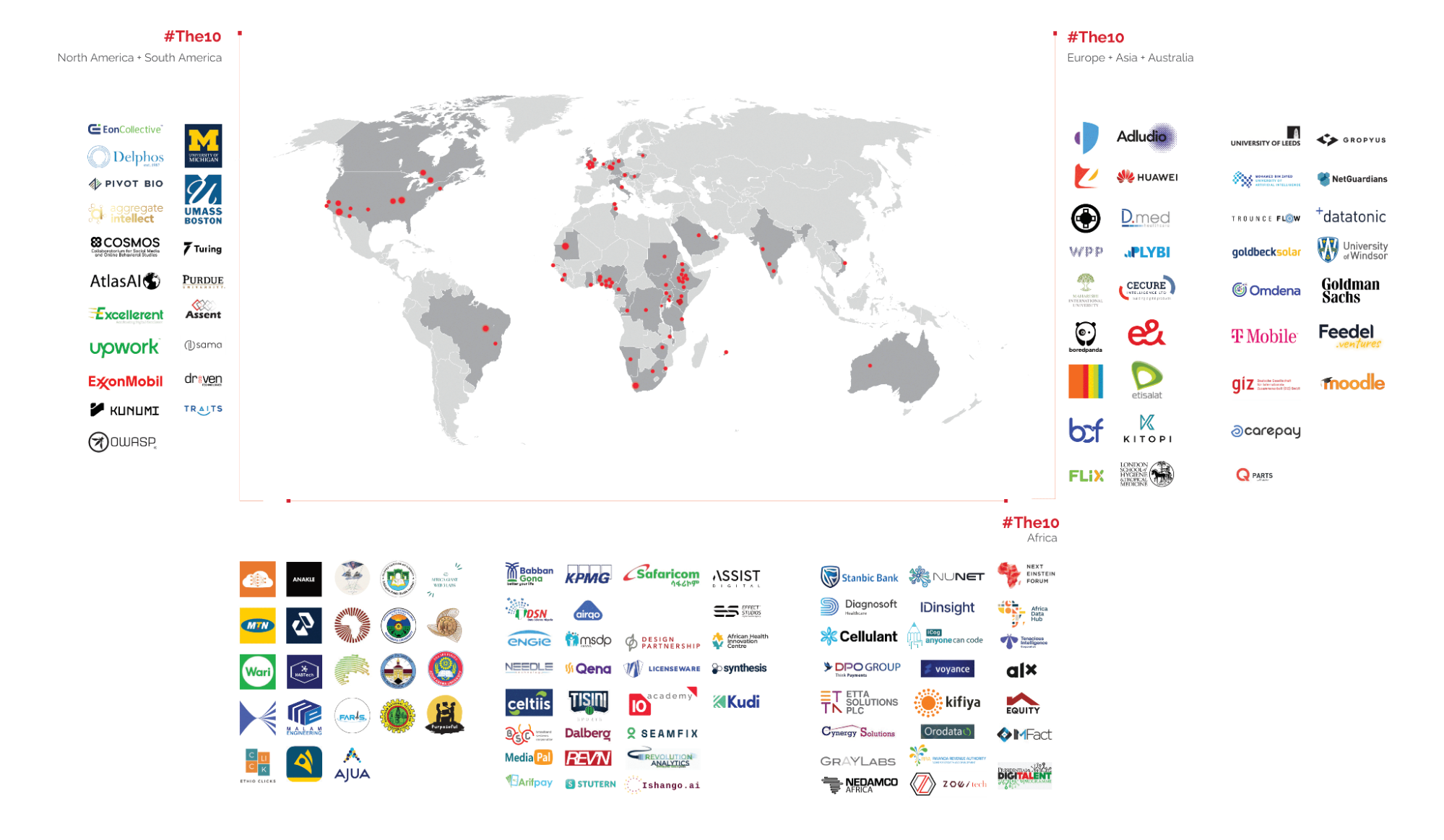
Discover the remarkable journeys of 10 academy's alumni as they pave their paths to success in prestigious positions and impactful roles around the globe.

World map showing where 10 Academy alumni are placed across North America, South America, Europe, Asia, Australia, and Africa, with logos of the companies and organizations they work at

FAQs

Yes. This is a full-time intensive training program. Learners should expect to commit around 40 to 50+ hours per week for 12 weeks.

Table of Contents

Have questions?

Not sure about something? Our admissions team is happy to help.

Have questions?

Leave your email and phone number, and our admissions team will reach out to answer your questions.

*