New: AI-Enabled Full-Stack Developer Training. Join the waitlist!

10Ac AIFSDT: AI-Enabled Full-Stack Developer Training

The 10 Academy AI-Enabled Full-Stack Developer Training Program is a 12-week intensive, fully remote program that prepares you for junior to associate-level careers in AI-enabled software development - from full-stack developer and AI product developer roles on engineering teams, to building AI-powered solutions for businesses and clients.

Over 12 weeks, you will build and ship real full-stack web applications, integrate AI capabilities using LLM APIs and recent AI coding tools, and develop the technical judgment and portfolio that employers and clients are actively looking for.

You leave with the skills to contribute from day one - not as someone who has learned about AI, but as someone who has built with it.

Join the waitlist

Applications open June 19, 2026. Join the waitlist and we'll email you the moment the application form goes live. Early interest, no commitment required.

*

The 10 Academy AI-Enabled Full-Stack Developer Training Program is a 12-week intensive, fully remote program that prepares you for junior to associate-level careers in AI-enabled software development - from full-stack developer and AI product developer roles on engineering teams, to building AI-powered solutions for businesses and clients.

Over 12 weeks, you will build and ship real full-stack web applications, integrate AI capabilities using LLM APIs and recent AI coding tools, and develop the technical judgment and portfolio that employers and clients are actively looking for.

You leave with the skills to contribute from day one - not as someone who has learned about AI, but as someone who has built with it.

Training Purpose

This program is designed for people who are serious about building something with the help of AI - a new career, a better role, or a product they have been trying to make happen.

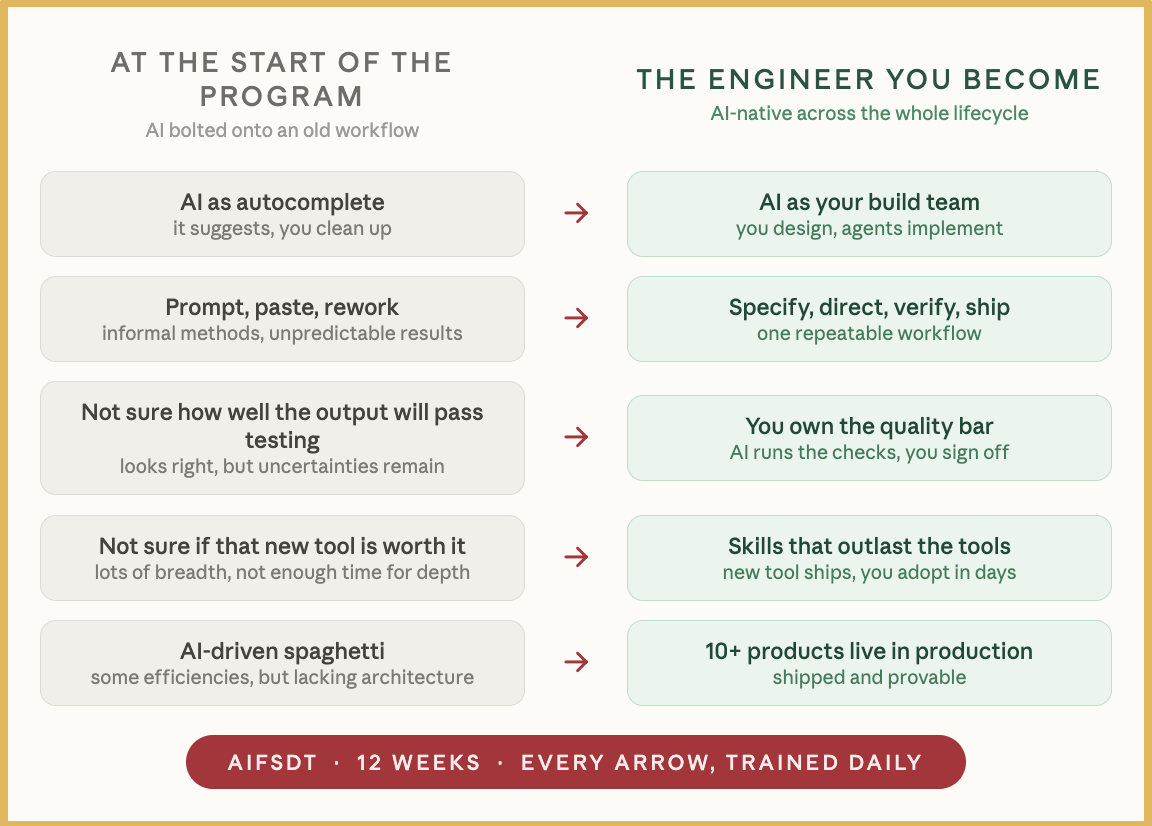
The goal is not only to teach you how to prompt or use AI as autocomplete. The goal is to train you to become an AI-enabled developer who can:

  • Build usable software products
  • Use AI across the development workflow
  • Support coding, testing, documentation and automation with AI
  • have technical judgment and clear communication skills
  • Create new or join existing teams and start contributing with confidence and creativity

How can this improve my career?

For early-career professionals and STEM graduates, the program will help you build the baseline skills needed for junior-level developer roles.

For working professionals, the course adds AI and software development capability to your existing experience making you more relevant in the market

For career switchers, technical project managers, product owners, business analysts, and other professionals with basic coding knowledge or a technical background who want to move into a hands-on developer role.

For mid-level professionals or people already close to tech, the program supports a move toward more advanced AI-enabled roles, such as AI product builder, AI solutions developer, or eventually AI architect-type roles within your domain.

Who This Program Is For?

This program is designed for people who already have some professional, academic, technical, or semi-technical foundation and want to become relevant and competitive in the AI market.

Profile

Description

Early-career professionals with 2-5 years of experience

You already have some technical exposure and want to become more competitive, land stronger or new roles, and demonstrate AI, software development, and product-building skills.

Working professionals with 5-8+ years of experience

You want to continue staying relevant, feel that the market is moving ahead, and want to use AI to solve real problems in your current work. You may want more job security, to perform better in your current role, or to move up into more advanced AI-enabled roles.

Fresh STEM graduates or people with little work history

You have a strong academic or technical foundation but limited professional experience, and you want to enter the job market with practical, portfolio-backed AI development skills.

People in semi-technical or STEM-related roles

You are in a role related to data, operations, research, analytics, or another semi-technical area, and you are highly motivated to transition into a technical role within 6–12 months after graduation.

Who Is the Right Fit?

You may be a strong fit for this program if you:

  • Have a professional background or academic foundation in a technical or semi-technical field
  • Are available full-time for the 12-week program
  • Can commit 40+ hours per week during the training period
  • Are motivated by a clear outcome, such as a new job, a better role, a product to build, or staying relevant in an AI-driven market
  • Are ready to do the work between sessions, not just attend live classes
  • Are comfortable with a structured and demanding learning environment
  • Want to leave the program with practical skills, real projects, a portfolio, and stronger job readiness
  • Understand that the program is designed to help you become more job-ready and competitive, and that your outcome will also depend on your effort, portfolio quality, consistency, and how you use the skills after the program

Prerequisites

No prior professional coding experience is required to apply. However, applicants with basic programming familiarity, especially in Python, JavaScript, or SQL, may move faster in the early parts of the program. Advanced Python, JavaScript, or SQL is not required.

Skill

Entry Expectation

What we expect

Programming Fundamentals

Recommended

Variables, conditionals, loops, functions, lists/arrays, objects/dictionaries, and writing small programs

Python

Helpful

Basic syntax, functions, file handling, working with data, and using packages

SQL

Helpful

SELECT queries, WHERE clauses, joins, simple table creation, and basic aggregations

Web Basics

Helpful

Basic familiarity with HTML, CSS, JavaScript, forms, pages, and APIs

Developer Tools

Helpful

VS Code, Git/GitHub basics, terminal/command-line basics, and installing developer tools

Advanced Python or SQL

Not required

OOP, async IO, generators, RegEx, window functions, subqueries, and query optimization are useful advantages but not expected at entry

Who Is Not the Right Fit?

This program may not be the right fit if you are:

  • Looking for passive content consumption with no deliverables
  • Expecting guaranteed employment
  • Unable to commit the required weekly hours during the full 12-week program period
  • Unable to meet the payment terms during the training period

Program Exit and Outcomes

On exit, graduates are expected to be AI-enabled full-stack developers who can build and deploy AI-powered web applications and use AI coding tools as part of a professional workflow.

This means you should be able to:

  • Build a working full-stack application using a React/Next.js front end, API back end, and database
  • Use tools like Claude Code, Cursor, or GitHub Copilot as active development tools, not just autocomplete
  • Integrate AI capability into an application, such as an LLM API, RAG-based document tool, or AI-powered feature
  • Build and present a portfolio of 10+ real-world projects
  • Clearly explain what you built in a job interview, team discussion, or client conversation

The realistic exit level is Junior to Associate, depending on your prior experience.

What the Program Does Not Promise

The program does not promise:

  • Immediate senior-level roles
  • Guaranteed job placement

The program builds your skills, portfolio, and job readiness. Your career outcome will depend on your prior background, your effort during the program, your portfolio quality, and your job search after graduation.

Program Timeline

Milestone

Date

Notes

Waitlist opens

12 June 2026

Early interest; no commitment required

Applications open

19 June 2026

Full application form goes live

Application closes

9 August 2026

Final deadline to submit the full application form

Screening period starts

10 August 2026

Assessment, interview, and alignment call

Program officially starts

8 September 2026 to 30 November 2026

First project introduction of the training. Week 1 will start at 9:00 AM ET.

Timezone and Delivery Model

The program is fully remote and designed around the US Eastern Time zone. Live sessions, standups, tutorials, and Q&A sessions will be scheduled within the Eastern Time window.

  • Live tutorials led by real tutors, not just recorded videos, with standups, Q&A, and community-building sessions
  • Live tutor support during active learning hours so learners are not stuck working alone
  • Fast response, with a target response time of 5 minutes
  • Peer support through an active cohort community, so learners can ask questions, share progress, and learn from each other
  • Slack/community support between live sessions to keep learners connected and moving forward
  • A fully remote learning experience that still feels active, structured, and on-site

Location / Region

Example Time Difference

New York, Boston, Washington DC, Atlanta, Miami

Same as ET

Toronto, Ottawa, Montreal

Same as ET

Vancouver

3 hours behind ET

Calgary

2 hours behind ET

Colombia, Peru, Ecuador, Panama

Same or close to ET, depending on daylight saving

Brazil

Usually around 1 hour ahead of ET

Jamaica, Trinidad, Barbados, and nearby Caribbean regions

Same or close to ET

Nigeria, Ghana, Senegal, Côte d'Ivoire

Around 4-5 hours ahead of ET

Ethiopia, Kenya, Uganda, Rwanda

Around 7-8 hours ahead of ET

Applicants outside the US are welcome to apply as long as they can adjust to the program schedule and consistently attend the required live sessions.

Training Duration and Weekly Commitment

The program runs for 12 weeks and is designed as a full-time, intensive training experience. Learners should expect to commit around 40-50+ hours per week across live sessions, guided build blocks, independent challenge work, project submissions, and presentations.

This is not a part-time evening course. It is built for people who can give the program serious attention for 12 weeks, whether they are between jobs, on a career break, or have employer support to train full-time.

Component

Approximate Hours per Week

Description

Live sessions

10-12 hrs

Daily standups, live tutorials, live coding, and Q&A sessions

Independent challenge work

20-25 hrs

Exercises, weekly challenges, and project build time

Project submissions and presentations

5-8 hrs

Mid-week submission, weekly project submission, and presentation preparation

Optional Saturday recap

Up to 3 hrs

Optional review and consolidation session

Total

40-50+ hrs

Full-time intensive commitment

High-Level Weekly Schedule

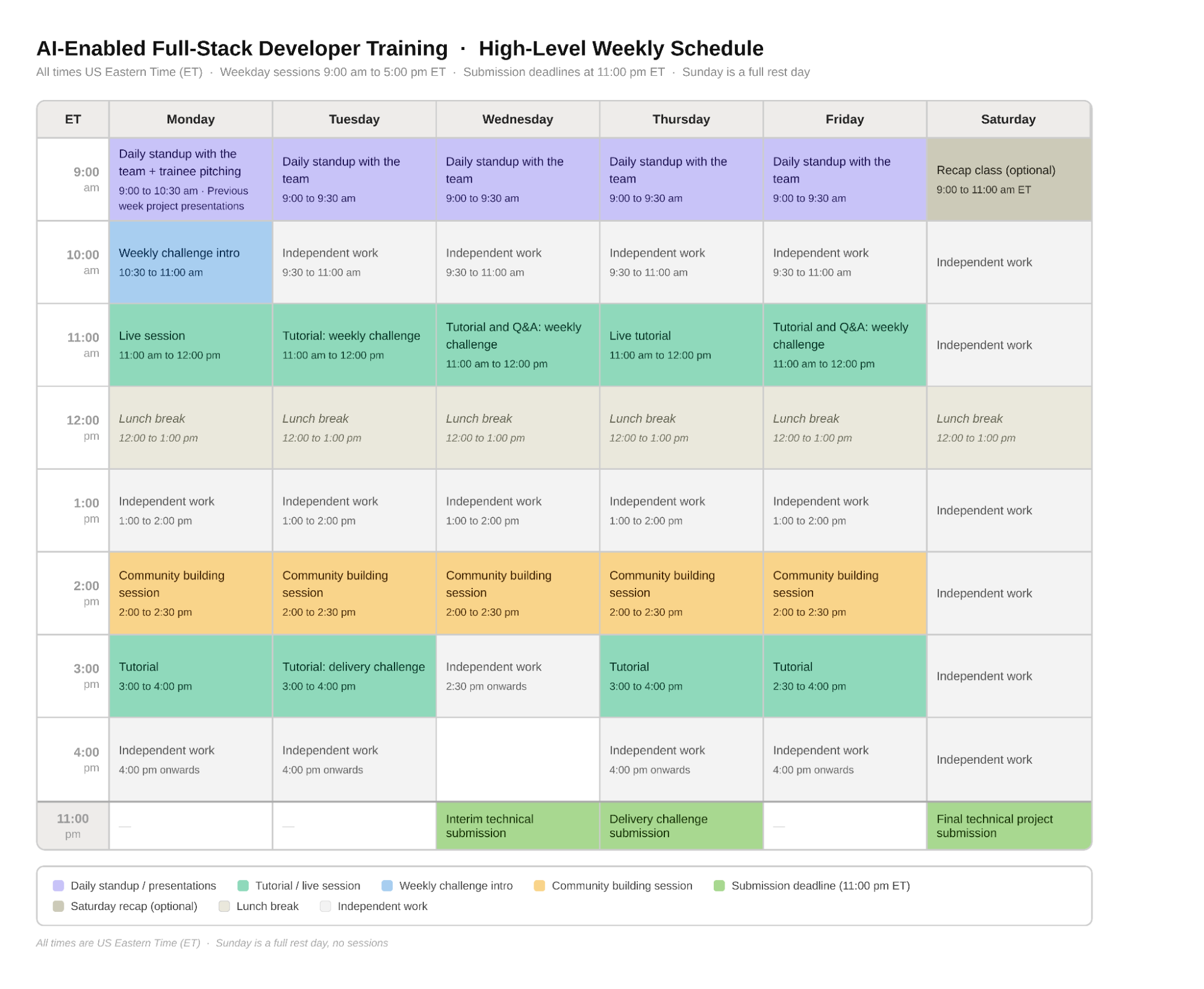
All times are planned around US Eastern Time. Weekday sessions will generally run within the 9:00 AM-4:00 PM ET window.

Here's what a typical project week could look like:

High-level weekly schedule calendar showing a typical project week in US Eastern Time, with daily standups, tutorials, independent work, community building sessions, and submission deadlines from Monday to Saturday

Program Pricing

Program fee: $3,500

The program fee covers the full 12-week training experience.

The cost helps cover the training team, live instruction, tutor support, project review, learning operations, platform/community support, and the delivery structure needed to run an intensive cohort.

The fee covers measurable program components, including:

  • 12 weeks of intensive, fully remote training
  • 40-50+ hours per week of expected learning, project work, and submissions
  • 10-12 hours per week of live sessions, tutorials, standups, and Q&A
  • 12 weekly industry challenges
  • 12 delivery challenges
  • 10+ real-world portfolio projects
  • Daily weekday standups
  • Weekly live tutorials and Q&A sessions
  • Optional Saturday recap classes
  • Slack/community support
  • Tutor and instructor support during the program
  • Industry expert sessions and guest talks
  • Project presentation and portfolio support
  • Job-readiness support in the final weeks

Payment Plan

A payment plan is available over the 3-month training period. Installments must be completed within the program duration.

A deposit is required to confirm your place.

Cohort Size

Each cohort targets 20 graduates.

The cohort size is intentionally small to support stronger instruction, closer tutor support, and a more active learning community.

Training Delivery

The program is fully remote. Instruction, support, and community interaction happen online through live sessions, project work, and async support.

The delivery model includes:

  • Daily weekday standups
  • Live tutorials
  • Live coding sessions
  • Weekly Q&A sessions
  • Weekly industry challenges
  • Delivery challenges
  • Independent project work
  • Community-building sessions
  • Slack and async support
  • Optional Saturday recap sessions
  • Industry expert sessions and guest talks
  • Project presentation and portfolio support
  • Job-readiness support in the final weeks

Industry Exposure

The program also includes exposure to industry practice through guest talks, expert sessions, and project feedback opportunities.

This may include:

  • Guest talks from professionals working in AI, software development, product, data, or engineering teams
  • Industry experts sharing how AI is being used in real teams and real products
  • Sessions on how developers use AI tools in day-to-day work
  • Talks on career paths, portfolio expectations, and what hiring teams look for
  • Feedback sessions on selected learner projects or presentations
  • Practical discussions on how to explain projects in interviews or client conversations

These sessions are designed to help learners connect what they are building in the program with how AI-enabled development is actually used in the market.

Skills, Tools, and Competencies

The program focuses on practical tools and workflows that are relevant to AI-enabled full-stack development today.

The exact tools may be updated as the market changes, but the learning areas will stay focused on building real products, integrating AI, and using professional development workflows.

Key Tools and Frameworks

Area

Tools/Languages

Platforms

Frameworks/Libraries

Front-End, UI and Product Build

JavaScript, TypeScript, HTML, CSS, component-based UI

Vercel, Netlify, Github

React, Next.js, Tailwind CSS, shadcn/ui, Radix UI, basic design systems

Authentication and App Security

Auth flows, sessions, JWT basics, permissions

Supabase, Clerk, GitHub, Google OAuth

Supabase Auth, Clerk, Auth.js

Back-End and APIs

Python, Node.js, REST APIs

Render, Railway, Vercel, AWS/GCP basics

FastAPI, Express, Next.js Route Handlers/Server Actions

Databases

SQL, PostgreSQL

Supabase, hosted PostgreSQL databases

Prisma or Drizzle for Typescript, SQLAlchemy for Python

AI Coding Tools

Claude Code, Codex, Cursor, GitHub Copilot

Anthropic, OpenAI, GitHub

AI-assisted development workflow

LLM and AI Integration

Python, JavaScript, prompt design, embeddings, structured outputs, tool/function calling

Anthropic, OpenAI, Google/Gemini

LangChain, Langgraph, LlamaIndex, Vercel AI SDK

RAG and AI Apps

Document processing, chunking, retrieval, vector search

Supabase, pgvector, hosted vector databases

RAG pipelines, embeddings, retrieval workflows

Testing and Quality

Testing, linting, formatting

GitHub

Playwright, Vitest/Jest, Pytest, ESLint, Prettier

Developer Workflow

Git, GitHub, VS Code

GitHub, Slack, Notion/Linear/Jira

Branching, Pull requests, code review, CI/CD basics

Deployment

Environment variables, build settings, logs

Vercel, Render, Railway, Supabase

Production deployment basics

Technology Areas Covered

Area

What You Will Learn

AI-Enabled Full-Stack Development

Build and deploy AI-powered web applications using modern front-end, back-end, database, and AI tools

Front-End Development

Build responsive and interactive user interfaces using React, Next.js, TypeScript, Tailwind CSS, and modern UI practices

Back-End and API Development

Build APIs, server-side logic, authentication flows, and database-connected applications

Database and Data Handling

Work with SQL, PostgreSQL, Supabase, data models, and database-backed application features

AI Integration

Add LLM APIs, tool/function calling, structured-outputs, RAG-based document tools, and AI workflow support into applications

Developer Workflow with AI

Use AI coding tools to support coding, testing, documentation, debugging, automation, and delivery

Deployment and Production Basics

Deploy applications, manage environment variables, use Git/GitHub, and understand basic production workflows

Project and Portfolio Development

Build, present, and explain portfolio-ready projects clearly for interviews, client conversations, or team discussions

Technical Competencies

By the end of the program, learners will have practical exposure to:

  • Application of AI in Full-stack web development
  • Front-end development with React/Next.js
  • Back-end API development
  • SQL and database-backed applications
  • AI-assisted coding workflows
  • LLM API integration
  • RAG-based document tools
  • AI-powered product features
  • Testing, debugging, documentation, and deployment
  • Git/GitHub workflow and basic code review
  • Portfolio project development and presentation

Career and Workplace Competencies

The program also supports workplace readiness through:

  • Technical communication
  • Project presentation
  • Remote team collaboration
  • Async communication
  • Interview preparation
  • Explaining AI-enabled products clearly to technical and non-technical audiences

Assessment and Admissions Process

Admission to the program is competitive. The process is designed to make sure each learner is ready for the pace, commitment, and expectations of the training.

Step

Stage

Description

1

Application form (will go live on 19 June 2026)

You complete the online application with your background, motivation, time commitment, technical exposure, and a short writing sample.

2

Timed assessment

You complete a timed assessment or equivalent task to check problem-solving, logic, and baseline technical aptitude.

3

Interview

A 20-30 minute structured conversation with the admissions team focused on motivation, time commitment, and program fit.

4

Simulation week

A 1-week simulation that mirrors the structure of the actual program, including standups, a challenge, and a submission.

5

Expectation alignment call

Final call before an offer is made to confirm schedule, payment, expectations, and any remaining questions.

Learner Support

Learners are supported throughout the 12 weeks through:

  • Daily weekday standups to keep progress visible and address blockers early
  • Live tutorials and Q&A sessions with instructors and tutors
  • Slack/community support between live sessions
  • Optional Saturday recap sessions for review and catch-up
  • Project presentation support
  • Portfolio review and job-readiness support in the final weeks
  • Active cohort community and peer learning
  • Guest talks and industry exposure where available

Our Supporters

TAC & Board Members

Our Technical Advisory Committee and Board Member is composed of AI professionals and individuals contributing to international-level tech curriculums. These experts ensure our training programs are cutting-edge, relevant, and aligned with global industry standards.

Their guidance and oversight help us maintain the highest quality of education and professional development for our trainees, preparing them to excel in a competitive international job market.

Organizations

GitLab Foundation collaborates closely with 10 Academy, catalyzing change in job training and placement. They invest strategically, create efficiencies in labor markets, and promote collective action, focusing on empowering individuals and families below a living wage, particularly disadvantaged groups.

Schmidt Futures takes a multi-faceted approach to driving innovation, spanning education, technology, and tackling global challenges. Through philanthropy and cutting-edge technology solutions, we jointly create lasting impacts in these critical areas. The Hopper-Dean Foundation, led by Jeff Dean, Chief Scientist at Google, aligns with 10 Academy's mission to advance STEM education globally. Emergent Ventures at the Mercatus Center at George Mason University connects academic learning with real-world practice, reflecting a shared commitment to nurturing future tech leaders.

Other partners & supporters include Algorand, Pivot Bio, Canva, Amazon, Replit, intel, Datacamp, Ashesi University, and others.

Alumni Community

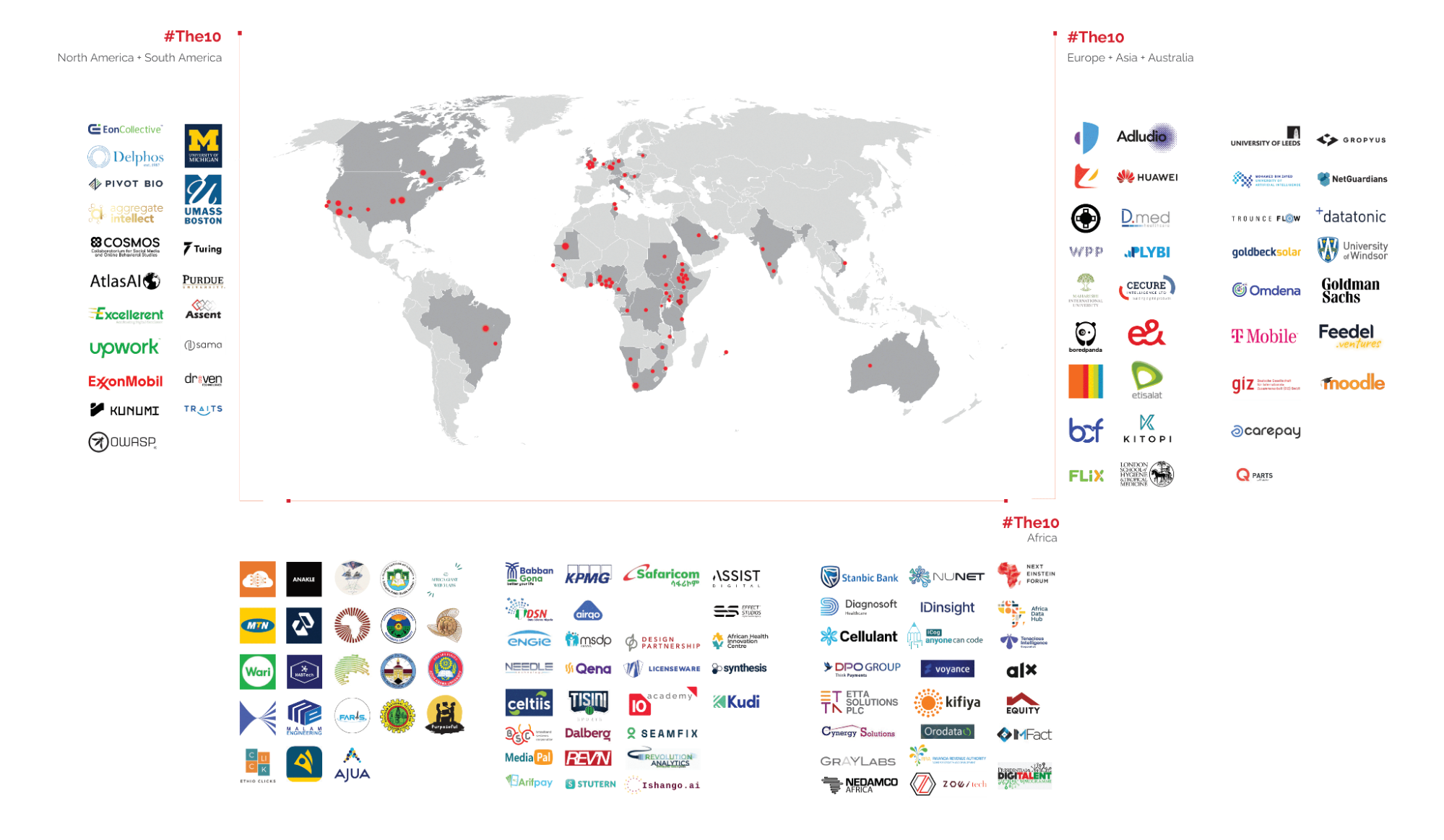
Our alumni are placed in different jobs around the world, contributing to diverse industries and communities. They play a significant role in giving back to their communities by sharing knowledge, mentoring new trainees, and participating in various initiatives that drive local and global impact.

Their achievements and continued involvement with 10 Academy underscore the effectiveness of our training programs and the strong network of support that extends beyond graduation. Our alumni embody the global reach and impact of 10 Academy, demonstrating excellence and leadership in their respective fields while fostering a culture of continuous learning and community contribution.

Discover the remarkable journeys of 10 academy's alumni as they pave their paths to success in prestigious positions and impactful roles around the globe.

World map showing where 10 Academy alumni are placed across North America, South America, Europe, Asia, Australia, and Africa, with logos of the companies and organizations they work at

Not-for-profit

10 Academy is a recognized 501(c)(3) nonprofit organization in the United States, solidifying our status as a dedicated educational institution with a focus on empowering talent in the tech field. This designation emphasizes our commitment to providing top-tier education and training opportunities, ensuring our students are equipped to thrive in the technology-driven landscape. It also opens doors for collaborations and partnerships that share our vision for a brighter future for African youth in the tech industry.

Contact Us

For more details, contact cohort manager Rodas at rodas@10academy.org or our team at support@10academy.org.

FAQs

Yes. This is a full-time intensive training program. Learners should expect to commit around 40–50+ hours per week for 12 weeks.

Table of Contents